


European Commission launches renewed single market strategy
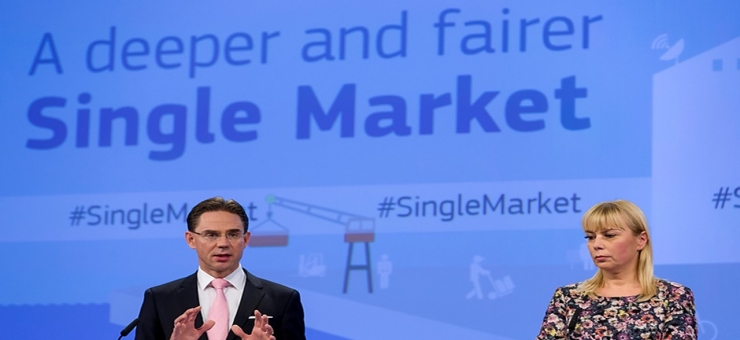


On 28 October 2015, the European Commission launched a renewed strategy for the single market for goods and services. Presenting the strategy, European Commission Vice-President Katainen and Commissioner responsible Bieńkowska stressed how the single market requires an overhaul in light of both the EU’s disappointing economic and social performance and in an age of rapid technological change.
UNI Europa welcomes that it is the Commission’s declared objective to make the single market ‘fairer’ in this process. The strategy published today recognises the need to protect employee rights and empowering workers and citizens in the single market. UNI Europa notices, though, that the strategy presents little detail as to how the Commission intends to achieve this. Therefore, we call on the European Commission to engage with trade unions with a view to adding a meaningful social dimension to the single market without further delay.
For UNI Europa, a number of the measures presented by the Commission today will be of particular concern in such exchanges.
As part of the single market strategy, the Commission intends to clarify how existing legislation applies to the ‘collaborative economy’ (commonly known as the ‘sharing economy') and the services of online platforms, including crowdsourcing platforms where companies outsource jobs to independent workers through tendering procedures. The Commission acknowledges that questions concerning the application of collective agreements, employment regulation, and social security law arise in the context of such services. Yet, the strategy published today only makes reference to the services directive and consumer protection regulation as the legal provisions whose applicability are to be clarified, without providing orientation as to how the enforcement of worker and social security rights is to be achieved. This is unacceptable to UNI Europa. We insist that the European Commission, in close cooperation with the social partners and Member States, conducts a thorough assessment of whether the collaborative economy creates risks for workers, wages, and job quality and, if so, how such risks can be eliminated.
To support companies seeking to provide services across borders, the Commission announces its intention of establishing the instrument of ‘services passports’. As part of this scheme, the authorities of a company’s home country would testify that the company complies with all regulatory standards required by the country in which it seeks to provide its services. This explicitly includes social and labour standards relevant in the context of the posting of workers. Effectively, this would mean that the country A would interpret and enforce the country B’s legislation. UNI Europa objects to such an arrangement as we doubt that the required competence and trust exists between Member States. Moreover, we fear that such arrangements are prone to fraud and regime shopping.
The Commission announces its intention to increase competition in the retail sector by eliminating barriers to market entry and other operational restrictions through future single market policy. The aim is to achieve higher growth and productivity through such a reinforcement of competition. UNI Europa’s experience shows, though, that similar measures taken in the past have mainly served to create a strong pressure on wages and working conditions in the affected sectors. UNI Europa is therefore opposed to the measures announced today as long as no flanking measures that protect wages and job quality in the sector are pursued.
Out of a concern that SMEs and microenterprises might suffer from the burden of single market regulation, the Commission announces measures to reduce said burden. During today’s press conference, Commissioner Bienkowska stated that the Commission is even pondering exempting such companies from certain legislative provisions. UNI Europa is strongly worried about this proposal and insists that the proper functioning of markets requires that all players are subject to the same balanced set of rules. Above all, employment and social standards must apply to all workers, irrespective of the size of the company they work for.
UNI Europa is open to engage with the Commission services responsible to discuss these and further issues in more detail. Creating a fair internal market is in the interest of all in the EU. Our analysis of the opportunities and risks the single market entails, as well as our proposals for tapping into its full potential are set out in our report ‘Towards a fair future for European services’.
Read here the European Commission's press release here